Monetising company data: how to export and secure it, and what buyers check
Luca Weber-SchäferUpdated 11 min read
Key points
- A company with 100 employees receives around 4.5 million emails in six years. German mid-sized companies together hold around 384 billion.
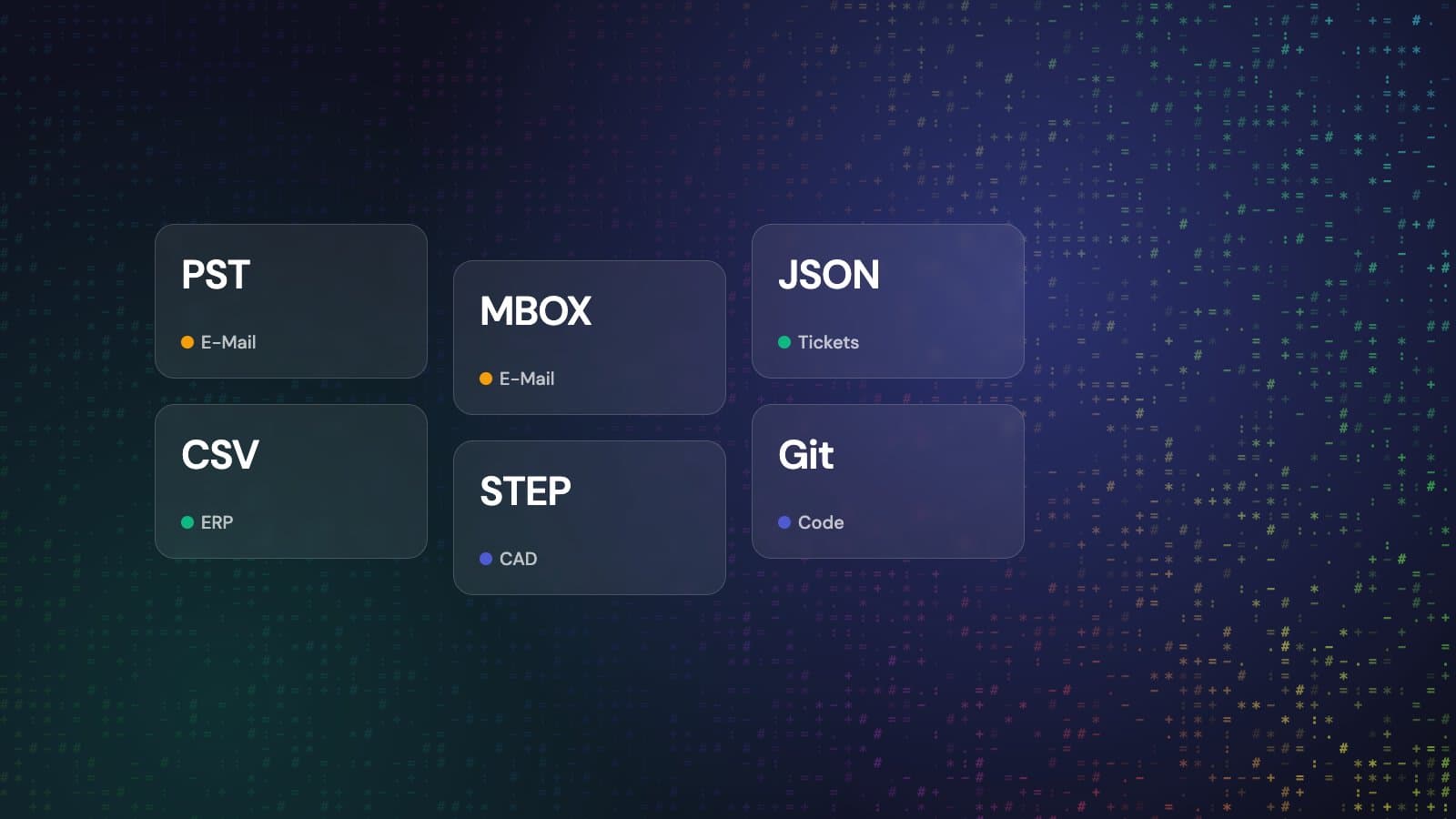
- Exports use the systems’ standard tools, in the native format and with all metadata.
- Exports are treated like backups: stored separately, encrypted and tested for restore. The originals stay unchanged.
- Buyers check rights and provenance, connected cases with an outcome, history and anonymisation. Since August 2025, AI providers must summarise their training data.
- Published price ranges run from around USD 50,000 to more than USD 2 million per dataset.
Many companies hold data that nobody opens any more: email archives, closed tickets, ERP history, years of engineering revisions. These are exactly the datasets AI labs are interested in, because they show how work in companies actually gets done. This article describes how much of it a typical company holds, how to export and secure it, and what buyers check.
How much data does a company hold?
More than most people think: a company with 100 employees receives around 4.5 million emails in six years.
The calculation rests on official and representative figures. Employees in Germany receive an average of 53 emails a day at their work address.[1] In companies with 50 to 249 employees, 64.9 percent of employees have internet access for work.[2] A company of that size has around 100 employees on average.[3] Under German law, business letters must be kept for six years, accounting vouchers for eight and books for ten.[4][5] Using the shortest of these periods and 220 working days a year:
- 65employees with internet access for work (64.9%)
- 53emails per day
- 220working days per year
- 6years of retention
- 4.5 millionemails received
Only received emails are counted. An email to several colleagues counts several times; sent emails are not included. The 220 working days are an assumption.
Scaled up to all 84,701 companies with 50 to 249 employees in Germany[3], that is around 384 billion emails within the retention period, plus around 870 billion in companies with 250 or more employees. For comparison: in the latest snapshot of Common Crawl, the open web archive that many AI training datasets are built on, 5.8 percent of 2.17 billion pages are in German, around 125 million.[6][7] Counted in documents, the email archive of a single mid-sized company therefore equals a good 3.6 percent of that, and the archives of all German mid-sized companies around 3,000 times as much.
Public text, meanwhile, is running short. Epoch AI estimates the stock of usable public text at around 300 trillion tokens and expects language models to have used it up between 2026 and 2032.[8] At the same time, more and more websites block AI crawlers: according to the Data Provenance Initiative, within one year more than 5 percent of all tokens in the C4 training dataset and more than 28 percent of its most important sources were blocked through robots.txt.[9] Internal company data were never public and are therefore in none of these datasets.
Step 1: Take stock
Before anything is exported, it is clear which systems exist, which periods they cover and what stays excluded.
- Systems: email, ticketing, ERP and accounting, CRM, file shares, CAD and PDM systems, code. Decommissioned systems count too, as long as an export or a backup exists.
- Period: From when to when do the data run, and were there system changes or gaps?
- Connection: Can cases be followed across several systems, for example from an enquiry by email through the order in the ERP to the ticket?
- Exclusions: Personnel files, health data, professional secrets and documents covered by confidentiality agreements with third parties are excluded or handled separately.
- Authority: Who may decide about the data? In an operating company the management, in insolvency the administrator.
Step 2: Export, system by system
With the systems’ standard tools, in the native format and with all metadata. Printouts and PDF exports lose exactly the details buyers need.
| System | Export route | Format | What to watch |
|---|---|---|---|
| Microsoft 365 | eDiscovery in the Microsoft Purview portal[10] | PST or MSG | PST packages up to 10 GB; export packages are deleted after 14 days; timestamps are preserved |
| Exchange Server | PowerShell command New-MailboxExportRequest[11] | PST | Export archive mailboxes too |
| Google Workspace | Google Vault[12] | MBOX or PST | Export Gmail, Groups and Chat separately |
| Own mail server | Export on the server or via IMAP | MBOX or EML[13][14] | Keep the folder structure and complete headers |
| Jira Cloud | Backup manager[15] | XML with attachments | Select attachments explicitly; recommended up to 25 GB; 48 hours between backups with attachments |
| Zendesk | Data export in Admin Center[16] | JSON, CSV or XML | The export must be enabled by Zendesk support; CSV omits ticket comments, so choose JSON or XML |
| ERP, accounting, CRM | The vendor's table or database export | CSV or SQL dump[17] | Include keys between tables and code lists |
| Code | git clone --mirror or git bundle[18] | Git repository | Full history with all branches, not just the latest state |
| CAD and PDM | File store in the native format | for example STEP, IFC, Inventor, Revit | No PDF exports; include revisions and bills of materials |
Large mailboxes take time. Microsoft cancels exports that run longer than seven days and recommends splitting large exports by date range or source.[10] What else to consider for engineering data is covered in the article Engineering data for AI training.
Step 3: Secure and verify
Like any backup: stored separately, protected against overwriting, encrypted and tested to show that everything can be restored.
The German Federal Office for Information Security sets out the requirements in module CON.3 of its IT-Grundschutz Compendium.[19] For exports intended for sale, that means:
- Store separately: backup media belong in a different location from the systems they back up, ideally in a different fire compartment (CON.3.A12).
- Protect against overwriting: write access only for authorised backups (CON.3.A14).
- Encrypt, and back up the keys separately (CON.3.A13).
- Test restores: check that the data can be restored correctly and within a reasonable time (CON.3.A15).
- Record checksums: note a SHA-256 hash for every export file. This makes it possible to show later that a copy is unchanged.
Transferring large datasets over the internet takes time: one terabyte needs around 22 hours at 100 Mbit/s upload and around 44 hours at 50 Mbit/s. That is why we anonymise locally at the seller, and only the anonymised export leaves the premises. How that works is described under Anonymisation.
Which formats buyers expect
Open, documented formats, one record per case and a description of the dataset.
- Email: EML or MBOX with complete headers. Message-ID and reply references make it possible to rebuild entire threads.[14]
- Tickets and cases: JSON with one case per line, including comments, status changes and timestamps. Zendesk already delivers its JSON export line by line, whereas its CSV export contains no comments.[16]
- Tables: CSV with a column description, for large volumes also columnar formats such as Parquet.[17]
- Code: Git repositories with full history.[18]
- Engineering: native formats with parameters instead of exports.
Every dataset needs a description. In research, the data sheet proposed in Datasheets for Datasets has become the norm: provenance, purpose, composition, collection and limitations of a dataset.[20] For machine-readable descriptions there is Croissant, a metadata format from MLCommons based on schema.org that major dataset platforms such as Hugging Face, Kaggle and OpenML support.[21][22] With us, every delivery includes an anonymous data sheet and an audit report on the anonymisation.
What buyers check
Verifiable rights, connected cases with an outcome, enough history and documented anonymisation. Volume alone rarely decides.
Since August 2025, providers of general-purpose AI models in the EU must have a policy to comply with copyright law and publish a summary of their training content using a Commission template.[23][24] Buyers therefore need datasets whose provenance and rights they can document.
| Criterion | What is checked | Example from the market |
|---|---|---|
| Rights and provenance | Who owns the data, are there third-party rights or confidentiality agreements? | AI Act: copyright policy and summary of training data[23] |
| Connection | Can cases be followed from start to outcome? | Labelbox looks for timestamps, user roles and the sequence of decisions[25] |
| Outcome | Is it clear how a case ended? | Labelbox: support histories with resolution tags[25] |
| History | How many years, without gaps? | micro1: several years across several systems; Labelbox: support histories of six months or more[26][25] |
| Company | Size and maturity of the business | micro1: 30 or more full-time employees[26] |
| Personal data | How are personal data removed, and how is that documented? | Labelbox and micro1 remove personal data before use[25][26] |
| Exclusivity | Does the buyer receive the dataset exclusively? | Labelbox licenses exclusively by default[25] |
Volume is secondary. Labelbox writes that value depends less on volume than on how authentically the data capture real work.[25] German-language datasets are also scarce: German makes up only 5.8 percent of the open web.[6]
Whether anonymised data are still personal data is judged from the recipient’s perspective: according to the CJEU, pseudonymised data are not personal data for a recipient who cannot restore the link with reasonable effort.[27] That is why buyers never receive the mapping table, and it is deleted after the handover.
What a dataset can earn
Published ranges run from around USD 50,000 to more than USD 2 million per dataset.
micro1 quotes USD 100,000 to 500,000 for qualified partnerships, USD 500,000 to 2 million for large or ongoing datasets and more than USD 2 million for highly unique data.[26] Labelbox quotes around USD 50,000 for smaller, targeted datasets up to more than USD 1 million for large partnerships, as an upfront fee at signing plus a share of later use.[25] How we estimate a dataset is described in the article What is company data worth?
Checklist before the first call
- List systems and periods, including decommissioned ones.
- Clarify who may decide about the data.
- Define exclusions and check contracts with customers and suppliers for confidentiality agreements.
- Test the export route on a short period.
- Secure exports as a copy: separately, encrypted, with checksums.
- Describe the dataset briefly: systems, period, volume, typical cases.
Frequently asked questions
How many emails does a mid-sized company have?
With 100 employees, around 4.5 million received emails over six years. The calculation uses 53 work emails per day (Bitkom, 2026), 64.9 percent of employees with internet access for work (Eurostat, 2025), 220 working days a year and the six-year retention period for business letters in Germany.
Can emails that must be retained be monetised?
The German retention duties under § 257 HGB and § 147 AO do not stand in the way as long as the originals remain unchanged. What is licensed is an anonymised copy. Data protection and third-party rights need to be checked separately.
In which format should company data be exported?
In the system's native format: PST, MBOX or EML for email, JSON or XML for tickets, CSV or database exports for ERP and accounting, Git for code and original files for CAD. PDF printouts lose the metadata buyers need.
Do data have to be anonymised before export?
No. The export happens inside the company and anonymisation follows, in our case locally on the seller's systems. Only the anonymised export leaves the company.
What do AI buyers care about most?
Verifiable rights and provenance, connected cases with a visible outcome, several years of history and documented anonymisation. Volume alone rarely decides.
Sources
- [1]Bitkom: “Beruflicher Mailverkehr erreicht neuen Höchststand (work email reaches a new high, in German)”, 13 January 2026
- [2]Eurostat: “Use of computers and the internet by employees by size class of enterprise (isoc_ci_cm_ps), Germany 2025”, retrieved 26 October 2026
- [3]Federal Statistical Office of Germany (Destatis): “Business register: enterprises and employees by size class, reference year 2024 (in German)”, as of 1 December 2025
- [4]Federal Ministry of Justice (Germany): “§ 257 HGB, retention of records”
- [5]German Federal Ministry of Justice: “§ 147 AO, rules on the retention of records (in German)”
- [6]Common Crawl: “Statistics of Common Crawl Monthly Archives: Distribution of Languages (CC-MAIN-2026-43)”, retrieved 26 October 2026
- [7]Common Crawl: “Statistics of Common Crawl Monthly Archives: Size of Common Crawl Monthly Archives”, retrieved 26 October 2026
- [8]Villalobos, Ho, Sevilla, Besiroglu, Heim, Hobbhahn (Epoch AI): “Will we run out of data? Limits of LLM scaling based on human-generated data”, June 2024
- [9]Longpre, Mahari, Lee, Lund et al. (Data Provenance Initiative, NeurIPS 2024): “Consent in Crisis: The Rapid Decline of the AI Data Commons”, July 2024
- [10]Microsoft Learn: “Export search results in eDiscovery”, retrieved 26 October 2026
- [11]Microsoft Learn: “New-MailboxExportRequest (Exchange PowerShell)”, retrieved 26 October 2026
- [12]Google Workspace Updates: “Export data from Google Vault in PST format”, September 2017
- [13]IETF: “RFC 4155: The application/mbox Media Type”, September 2005
- [14]IETF: “RFC 5322: Internet Message Format”, October 2008
- [15]Atlassian Support: “Export data from Jira Cloud”, retrieved 26 October 2026
- [16]Zendesk Help Center: “Exporting ticket, user, or organization data from your account”, retrieved 26 October 2026
- [17]IETF: “RFC 4180: Common Format and MIME Type for Comma-Separated Values (CSV) Files”, October 2005
- [18]Git: “git-bundle Documentation”
- [19]German Federal Office for Information Security (BSI): “IT-Grundschutz Compendium, module CON.3 Data backup concept (2023 edition, in German)”
- [20]Gebru, Morgenstern, Vecchione, Wortman Vaughan, Wallach, Daumé III, Crawford (Communications of the ACM): “Datasheets for Datasets”, December 2021
- [21]Akhtar et al. (MLCommons, NeurIPS 2024): “Croissant: A Metadata Format for ML-Ready Datasets”, 2024
- [22]MLCommons (GitHub): “Croissant: Integrations”, retrieved 26 October 2026
- [23]EUR-Lex: “Regulation (EU) 2024/1689 (AI Act), Art. 53”
- [24]European Commission: “Template for General-Purpose AI model providers to summarise their training content”, 24 July 2025
- [25]Labelbox: “Prism: Data licensing”, retrieved 26 October 2026
- [26]micro1: “Monetize your company's operational data”, retrieved 26 October 2026
- [27]beck-aktuell: “CJEU, judgment of 4 September 2025, C-413/23 P (EDPS v SRB): pseudonymised data passed to third parties (in German)”, 5 September 2025
The projections are based on the sources cited and the assumptions stated. Market information as of 26 October 2026. This article does not replace legal advice in the individual case.
What is your dataset worth?
Nine questions, no data needed, no upfront costs. You receive a first estimate.